
Geneva Fishing Charters
Geneva fishing charters give anglers direct access to Lake Erie’s Central Basin reefs, offshore contour lines, nearshore structure, and migratory bait corridors holding walleye, steelhead, smallmouth bass, and seasonal yellow perch.
TrustedFish connects anglers with proven local captains in Geneva —no commissions, no pay-to-play listings, no BS. Every charter on our platform is invite-only, vetted for skill, local knowledge, and reputation. If they’re listed, they’ve earned it.
Top Rated Charters in Geneva
Geneva Fishing Guide
Geneva fishing charters operate on Lake Erie’s Central Basin, a wide, open-water system driven by wind direction, temperature gradients, plankton blooms, and migrating bait schools. These factors reshape fish position daily. Walleye may push offshore to deeper contour lines overnight, steelhead may suspend based on thermocline shifts, and smallmouth frequently relocate between rock transitions and nearshore breaks depending on clarity. DIY anglers often spend hours running empty water because productive lanes move quickly. Local guides remove this uncertainty by reading surface temperature maps, sonar returns, bait density, and clarity bands to position anglers on the highest-percentage zones from the start.
The Central Basin functions like a living conveyor belt. As bait migrates east and west, walleye track those movements across miles of open water, holding on suspended bands or along subtle elevation changes where prey collects. Smallmouth concentrate on breaks, ledges, and isolated rock, feeding aggressively when wind improves water movement without destroying visibility. Steelhead suspend far higher in the column, favoring cooler layers and tracking alewife schools. Geneva fishing guides monitor thermocline depth, trolling speed, lure spread configuration, and drift cadence to match each species’ feeding behavior. This precision transforms a large, complex lake into a structured, predictable fishing experience for every skill level.
Popular Fishing Areas
Nearshore Breaks & Rock Transitions
Nearshore structure along Geneva State Park features rock piles, breaklines, and depth transitions that concentrate smallmouth bass, early-season walleye, and post-spawn migrations. Clarity is the primary driver—clean water pulls smallmouth tight to rock, while stained conditions push them deeper. Early summer brings walleye into reachable depths before they follow bait offshore. Wind direction dictates where bait collects, often activating one shoreline while shutting down another. Guides use sonar and controlled drifts to match bottom contour, ensuring baits stay within the narrow strike zone along each transition.
Central Basin Offshore Contours
Offshore waters between 50–70 feet form the primary summer and fall walleye migration corridor. Subtle contour changes, mudlines, and temperature layers determine where walleye suspend. These fish often travel horizontally with bait, making location fluid. Thermocline stability is critical—when it holds steady, fish stack predictably; when storms disrupt it, fish scatter. Geneva guides use trolling programs with planer boards, divers, and precision depth presentations to maintain lure placement in the correct water column. Speed, angle, and lure color shift constantly based on clarity bands and bait density.
Steelhead Temperature Lines
Steelhead in the Central Basin hold along temperature breaks and offshore bait concentrations, often suspending far above walleye schools. They prefer cooler, high-oxygen layers, rising or dropping depending on wind-driven surface mixing. Productive water forms where warm and cold layers collide, drawing alewives and other forage. Guides run higher-spread trolling lines and precise planer board distances to intercept suspended fish. Action peaks when stable weather preserves defined temperature bands across multiple days.
Geneva Shoals & Hard-Bottom Pockets
Geneva Shoals and surrounding rocky pockets create consistent smallmouth habitat. Mixed rock, gravel, and sharp drop-offs hold fish throughout the warm season. Calm, clear days put fish deeper, while wind-driven chop activates shallow feeding. Walleye occasionally push across these structures during transitional periods. Guides target specific shelves based on bait presence, clarity, and light conditions, using vertical presentations or casting patterns matched to fish positioning.
Extended Target Zones
Ashtabula Offshore Line
East of Geneva, the Ashtabula offshore corridor holds massive schools of migrating walleye during summer. Stable temperature layers and consistent bait density make this a high-percentage zone when Geneva offshore waters scatter. Long trolling passes across contour edges, mudlines, and thermal pockets produce steady action. Guides shift between harnesses, spoons, and crankbaits depending on water clarity, fish depth, and barometric trends.
Sandbar Ledges West of Geneva
Shallow-to-deep sandbar transitions west of Geneva create predictable feeding lanes for both walleye and smallmouth. Bait collects along soft-to-hard edges, pulling predators into narrow, repeatable routes. Morning low-light periods often produce aggressive fronts of feeding fish before they disperse. Guides focus on precise drift angles early, then switch to deeper trolling spreads as sun and boat traffic increase.
Fishing Seasons in Geneva
Spring
Spring brings post-spawn walleye migration across the Central Basin, with fish moving eastward and holding along nearshore breaks before shifting deeper. Smallmouth concentrate around hard-bottom areas as water warms, offering strong pre-spawn action. Clarity improves steadily, activating crankbait and jig programs. Steelhead remain offshore or along deeper edges until stable warmth pulls bait higher. Guides focus on contour-oriented drifts, transitioning to light trolling as fish reposition daily.
Summer
Summer provides peak offshore walleye action as fish suspend along thermal layers, feeding aggressively on shad and alewives. The thermocline establishes predictable depth bands, allowing guides to run dialed-in trolling programs. Smallmouth move to deeper rock and ledges, while steelhead spread across temperature lines offshore. Stable weather improves consistency; heavy storms can scatter fish temporarily, requiring rapid repositioning.
Fall
Fall brings cooling temperatures and heavy bait consolidation, creating excellent mixed-species opportunities. Walleye push back toward mid-depth contours, feeding hard ahead of turnover. Smallmouth return to moderate depths and feed aggressively along rock transitions. Steelhead action improves along offshore breaks as surface temperatures drop. Guides adjust presentations to slower speeds and more natural profiles as fish respond to decreasing water temperatures.
Winter
Winter reduces boat traffic and concentrates walleye along deeper structure and stable temperature pockets. Feeding windows shorten but remain consistent with proper depth control. Nearshore areas can produce strong jigging opportunities during calm periods. Steelhead move toward river mouths, offering occasional open-water intercepts depending on weather. Guides rely on controlled drifts, precise jig weights, and electronics to track tight winter schools.
Top Gamefish in Geneva
- Walleye – 2–10 lbs Suspend along offshore contours and thermal layers. Strong headshakes and sustained runs. Best during summer and fall migrations when bait schools consolidate.
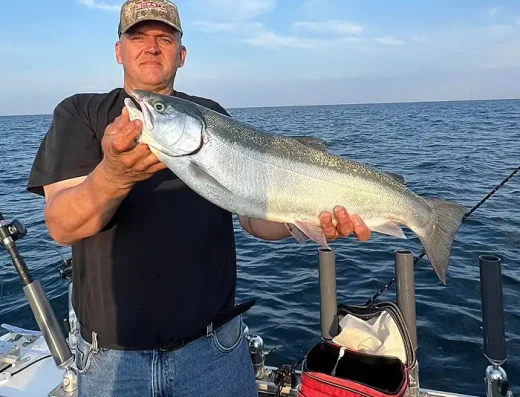
- Steelhead – 4–12 lbs High-speed, surface-breaking fighters holding along temperature lines. Suspend above walleye schools. Peak action during stable summer and fall conditions.
- Smallmouth Bass – 2–6 lbs Hold on rock transitions, breaks, and shoals. Hard strikes with vertical jumps. Most active during warm months and fall feeding pushes.
- Yellow Perch – 0.5–1.5 lbs School tightly along soft-bottom edges and mid-depth basins. Fast, subtle bites. Best in late summer and early fall when stable water concentrates schools.
- Lake Trout – 5–20 lbs Deep, powerful fish holding near bottom contours. Slow, heavy fights. Present in cooler seasons and transitional temperature periods.
Geneva Fishing FAQs
What species can I catch with Geneva fishing charters?
Walleye, steelhead, smallmouth bass, yellow perch, and seasonal lake trout depending on temperature and migration.
Do I need experience to fish Lake Erie?
No. Guides handle trolling spreads, boat control, electronics, and depth management.
When is the best time to fish Geneva, OH?
Summer for offshore walleye and steelhead, spring and fall for smallmouth and transition walleye, and late summer for perch.
Are trolling trips common?
Yes. The Central Basin is primarily a trolling fishery for covering depth and tracking migratory schools.
Do charters provide all gear?
Yes—rods, tackle, boards, divers, safety equipment, and electronics are included.